Key insights from
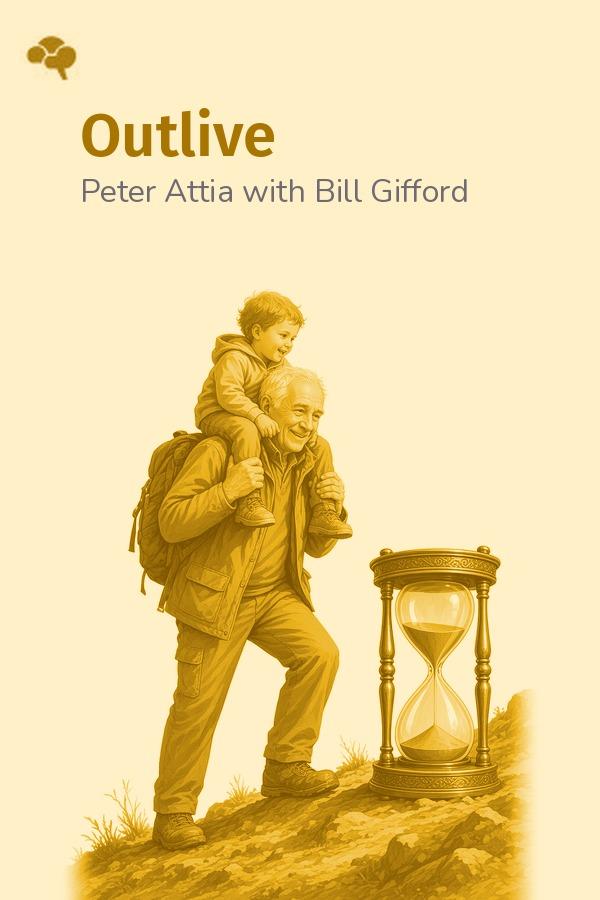
Outlive
What you'll learn
Peter Attia is a physician who earned his medical degree at Stanford, trained in surgery at Johns Hopkins and in surgical oncology at the National Cancer Institute, and now runs a medical practice focused on longevity; he also hosts the podcast The Drive. In Outlive, Attia and the science journalist Bill Gifford argue that mainstream medicine steps in too late against the chronic diseases that kill most of us. Instead, Attia proposes a proactive strategy he calls Medicine 3.0. He explains how heart disease, cancer, Alzheimer’s disease, and metabolic dysfunction develop over decades, why exercise is the most powerful longevity tool we have, how to think about nutrition and sleep, and why emotional health matters as much as any blood test.
Key insights
- 1 Medicine must shift from treating disease after it strikes to preventing it years in advance, an approach Attia calls Medicine 3.0.
- 2 Most of us will die slowly from one of four chronic diseases, and each of them takes root decades before it is diagnosed.
- 3 Longevity means extending healthspan as well as lifespan, so that our final decade is lived with strength, clarity, and joy.
- 4 Metabolic dysfunction, often beginning as an unnoticed fatty liver, quietly sets the stage for the other deadly diseases of aging.
- 5 Heart disease is driven by apoB particles in the blood, so the best defense is to lower them early and keep them low for life.
- 6 Late-stage cancer remains hard to cure, so our best weapons are prevention, smarter therapies, and detecting tumors far earlier.
- 7 Alzheimer’s disease develops over decades, and the same habits that protect the heart and metabolism also help protect the brain.
- 8 Exercise is the most powerful longevity drug we have, and training for a personal Centenarian Decathlon turns it into a lifelong plan.
- 9 A complete training plan builds aerobic endurance, peak cardiovascular capacity, strength, and stability, each through its own kind of work.
- 10 Instead of following a fashionable diet, we should use data and feedback to adjust how much we eat, what we eat, and when we eat.
- 11 Sleep is a pillar of long-term health, and chronic sleep loss quietly undermines everything from insulin sensitivity to memory.
- 12 Living longer means little without emotional health, a lesson Attia learned only after his own anger and unhappiness nearly cost him his family.
Similar titles