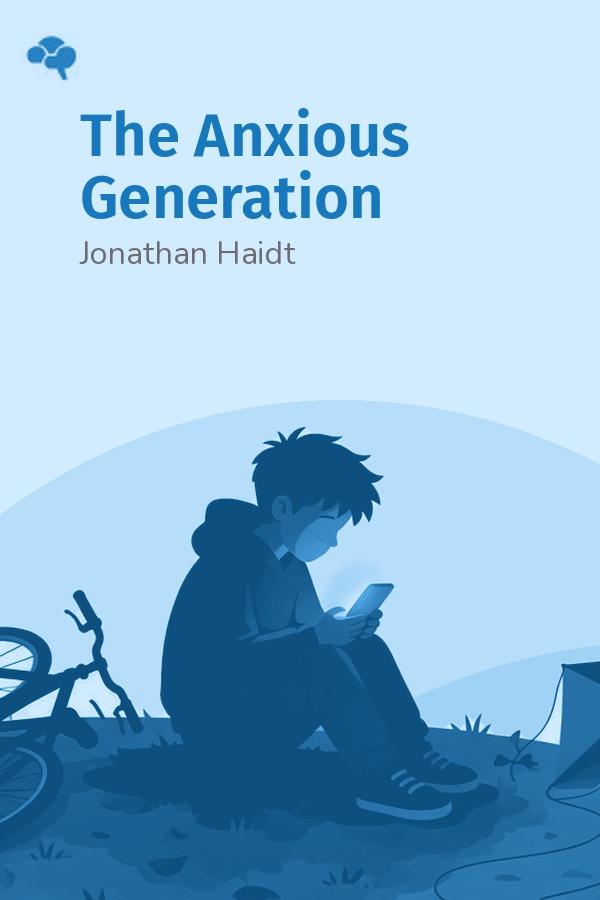
Key insights from
The Anxious Generation
What you'll learn
Jonathan Haidt is a social psychologist at New York University's Stern School of Business and the author of The Righteous Mind and, with Greg Lukianoff, The Coddling of the American Mind. In The Anxious Generation, Haidt asks why rates of anxiety, depression, and self-harm among adolescents suddenly soared in the early 2010s. His answer is what he calls the “great rewiring of childhood”: the shift from a play-based childhood, full of unsupervised play and real-world risk, to a phone-based childhood lived on smartphones and social media. Haidt explains how that shift harms girls and boys in different ways, how it erodes our spiritual lives, and what parents, schools, tech companies, and governments can do together to give children back a healthier, freer childhood.
Key insights
- 1 Adolescent mental health collapsed so suddenly in the early 2010s that a new cause, not a slow cultural drift, must be to blame.
- 2 Children are wired to learn through free play, attunement, and imitation, and those experiences cannot be postponed without cost.
- 3 Overprotection in the real world and underprotection in the virtual world have left a generation stuck in defend mode.
- 4 The phone-based childhood crowds out development through four harms: social deprivation, sleep deprivation, attention fragmentation, and addiction.
- 5 Social media harms girls more than boys because it exploits their concern with appearance, relationships, and belonging.
- 6 Boys have been drawn out of the real world and into virtual ones, leaving many of them unprepared for adult life.
- 7 A phone-based life degrades us spiritually, and ancient practices of reverence, stillness, and community offer an antidote.
- 8 The phone-based childhood is a collective action trap, and it can be escaped only if families and communities change their norms together.
- 9 Governments, tech companies, and schools can make the healthy choice the easy choice for families.
- 10 Parents can restore a healthier childhood by granting more real-world freedom and less screen time, even while scholars debate the evidence.
Similar titles